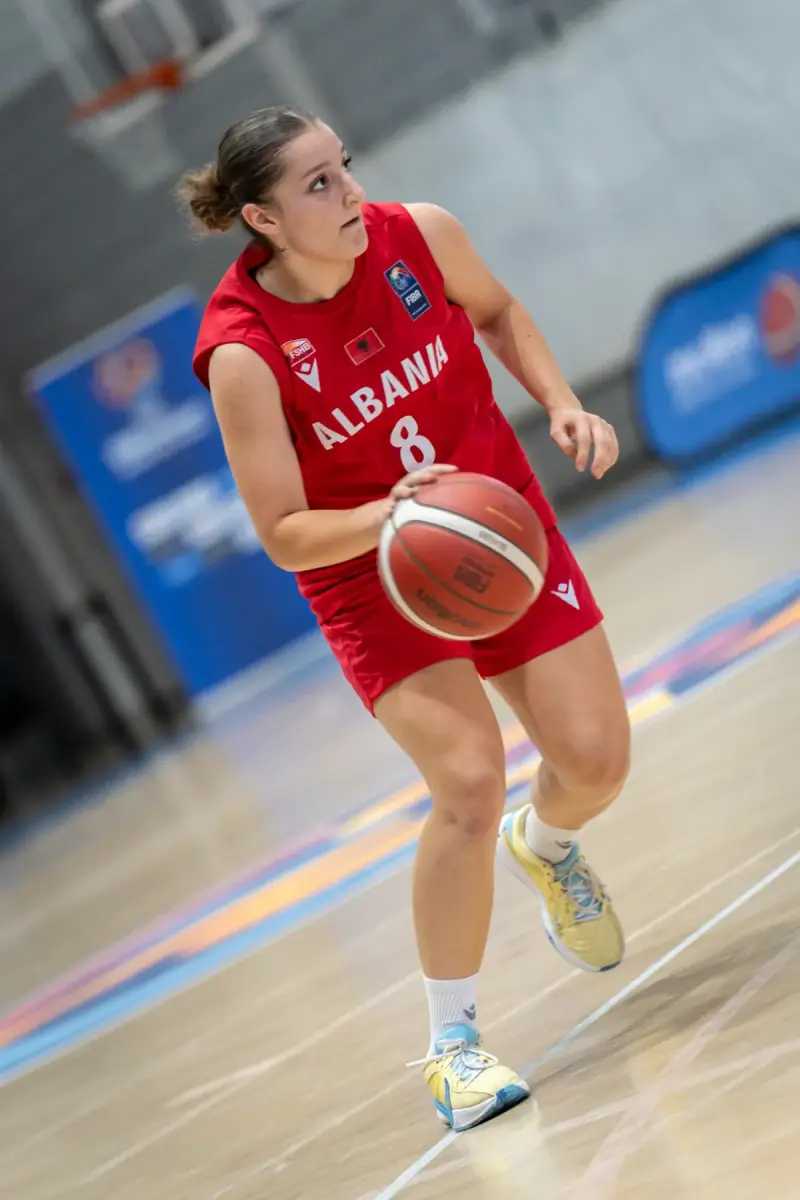
There is something beautiful about watching a dream become bigger without losing the feeling that started it. For Emily Tershalla, basketball has travelled with her from the courts of Albania to college basketball in the United States, through national championships, European youth tournaments, difficult moments, friendships and opportunities she once could only imagine. At 19, she already carries experiences from different basketball worlds with her, yet the enthusiasm underneath them still resembles that of the girl who simply saw her friends playing a sport and wanted to join them. She has grown into an Albanian international and a college basketball player who is preparing for her second season in the US. She will play for Meridian Community College. Her journey has required talent, work and courage, although perhaps its most compelling quality is the way Emily continues to find inspiration everywhere she goes. She looks at players ahead of her and wants to learn. She looks at younger Albanian girls and understands the challenges they face. She can even look back at the seasons in which things did not go her way and recognize how much they gave her. Photo: FIBA Basketball
A love that appeared before basketball became a serious ambition
Emily was in fifth grade when basketball entered her life. There was no carefully constructed sporting plan behind that beginning. Curiosity came first. Seeing friends play made her want to discover the game herself, and the connection was almost immediate. “To be honest, I feel like it was love at first sight,” Emily says. “I really enjoyed playing basketball even before I became serious about it. I saw some of my friends playing, and I became very interested in the sport.”
Enjoyment gradually became dedication. Training was no longer limited to organized team sessions as Emily started investing additional hours in herself through individual workouts and daily practice. The more she discovered, the more she wanted to develop. “When I was younger, I looked up to an Albanian basketball player named Julian Hamati. I really liked his work ethic, and because he kind of plays my position, I really liked the way he played. There is not only one player I look up to, though. In women’s basketball, I really like Paige Bueckers. She is very good and she is tough.”
Tirana helped shape the player who was ready to dream further
SK Tirana became the club behind a significant part of Emily’s basketball education. She remained with Tirana throughout her years in Albanian club basketball and experienced considerable success there, including two U16 and two U18 championships. The medals tell one part of that period. The work behind them tells considerably more. Tirana gave Emily coaches who demanded effort and teammates with whom she could develop. Training, running and the discipline attached to improvement became normal parts of her basketball life. The club also brought her into contact with foreign players, widening a world that would eventually stretch far beyond Albania. “They did a lot for me and helped me grow into the player that I am right now. Our coaches put us through workouts and made us run and do all those things. I think I am where I am because of them. I also gained a lot of connections with foreign players, which was very helpful.”
Her appreciation for that foundation becomes even more meaningful when looking at where basketball would eventually take her. Tirana was never merely a place where Emily collected championships. Her international development was unfolding alongside it.
Albania first taught her how to deal with the minutes she didn’t receive
Wearing the color of your country can make a young player feel as though she has arrived somewhere special. Emily experienced that excitement when she joined Albania’s U16 national team. Her first tournament, however, also confronted her with something every ambitious athlete eventually has to navigate: wanting to contribute much more than circumstances currently allow. Emily was inexperienced and received limited playing time. Rather than allowing that disappointment to define her relationship with the national team, she eventually understood it as one of the formative chapters of her development. “That year was character development, to be honest. It was my first year with the national team, and I was super happy and excited to be there, although I did not play as much because I was new. That year helped me build the character that I have now. After that year, I feel like I blossomed because I started working more. I was not where I wanted to be, so it was not the best year, but it helped me a lot.”
That transformation captures something essential about her. Progress did not arrive because the difficult first experience disappeared. Progress came partly because she allowed that experience to challenge her. One of the games from that next stage still makes her smile. Against Andorra, she came close to recording a double-double without even being particularly conscious of the numbers she was producing. “I remember the game against Andorra. I did not even notice how well I was doing. My coach told me, ‘You had a great game,’ and I was like, ‘Really?’ It was crazy. I miss those moments. Playing youth basketball is one of the best experiences that girls like me can have.”
Her national-team journey continued from U16 to U18, where one particular summer stands above the rest. Albania competed in Division C in Kosovo and finished third. Emily remembers the result fondly, although her strongest recollection is not centered on one possession, one performance or even one medal. She remembers how the team felt. “I would not say there was one particular game. It was the whole U18 season that I really liked. We were playing in Division C in Kosovo, and that year we finished in third place. Our whole team had very good chemistry. Everything felt right, and I really loved that year.”
That ability to value the collective makes her ambition feel richer. She wants to become better without losing sight of the people beside her.
America asked Emily to step into an entirely different basketball world
A connection made through basketball eventually opened another door. Emily knew a player who had studied and played at Casper College, and through her she was introduced to the coaching staff. The possibility of playing in the United States suddenly became tangible. Leaving Albania to study and play basketball abroad was a considerable transition. College basketball introduced Emily to another structure, another rhythm and another level of organization. Technical detail received greater emphasis, while the daily environment around the sport felt different from what she had previously known. “It was a big change, and I do not really know how to explain it. The way sport is approached there is very different. I would say it is more organized, and college basketball is very focused on technical aspects of the game. I really enjoyed my experience in the States. The coaching and the way everything was organized were very different.”
The move represented much more than changing teams. Emily had to leave the familiarity of Albania and discover how she fitted into an American college environment, both as a young woman and as an athlete. The national team continues to provide experiences that carry different emotional weight. Her first U20 campaign brought another significant step when Albania competed in Division B. The difference was immediately noticeable. Facing countries such as Greece exposed Emily to players of her own generation operating at a level Albania does not encounter regularly. Results were difficult. Albania did not win a game, although Emily refuses to reduce the value of that summer to a standings table. A close opportunity against Romania showed that there were moments to compete, while the overall standard provided something perhaps even more valuable: perspective. “It was definitely a good experience. Even though we did not have a good tournament and did not win any games, we could have won against Romania. I really enjoyed it, and it made me more motivated. When you see girls who are my age making basketball look so easy and enjoyable, you think, ‘I want to do the same.’ They inspire me too, and that is why going there is important.”
That mentality becomes particularly powerful when age removes one of the easiest excuses a young athlete can make. “Especially when they are your age, you can see that you can make things happen. Albania at U20 level is probably more suited to Division C right now, but going to Division B was still a very good experience for us. Being there and seeing that level is important.”
Emily still has another year of U20 eligibility ahead of her. The player returning to that environment will carry more college experience, more international basketball and another year of deliberate development with her.
Her own journey has made her see the talent Albania could lose
Emily knows the country has young players with ability and genuine love for the game. She also knows passion alone cannot create the infrastructure necessary for every talented player to reach her potential. “I feel like we have a lot of talent in Albania. We have many people who really love playing basketball, and there are some very good prospects. The problem is that basketball is not supported enough, so it is difficult for those talents to grow. I know so many young girls who are like me and have so much passion. It is hard for them. It is not impossible, although it can be very difficult.”
The challenge becomes even greater once youth basketball ends. Education, employment and everyday responsibilities begin competing with a sport that may demand significant commitment without offering enough financial security in return. For some players, continuing simply stops being realistic. “When players finish the U18 and U20 leagues in Albania, many of them do not want to continue because they do not get paid enough. They have to study and they have jobs, so continuing to play is not beneficial for them. That is one of the reasons why it becomes difficult.”
She knows what it feels like to sit while others play. She has worked herself from limited minutes into a starting role. She has celebrated championships with the club that developed her, shared a special international summer with teammates she still remembers fondly, competed against stronger European nations and crossed an ocean to continue playing the sport she first loved as a child. None of those steps have made her feel finished. They have made her want to discover more. Her advice to young players consequently comes from experience rather than from an idealized version of success. “Just keep working. Sometimes you should not wait for the opportunity to come to you. You should go and find it yourself, especially when you are in these kinds of situations.”
Those words fit Emily really well. Her journey began with seeing other children playing basketball and feeling drawn towards them. Years later, she is still looking around her, only the horizon has changed. She can look towards players such as Paige Bueckers and admire their toughness. She can watch European opponents her own age and turn their level into motivation. She can look back towards Albania and see girls carrying dreams similar to the one she once had.
At 19, she has already travelled from the courts of Tirana to the national color of Albania and onwards to Meridian Community College in the United States this season. Her talent has made those steps possible, while the character developed between the victories has helped her keep taking them. The love that began in fifth grade remains at the center of it all. That is the most beautiful part of Emily’s journey so far. Basketball has allowed her world to become larger, yet she has continued to carry her beginnings with her. Every new environment adds something without erasing what came before. Albania remains home, Tirana remains part of the player she became, her national-team memories remain precious, and America has become another place where she can keep building. Emily has already learned one lesson that may prove more valuable than any statistic she records along the way: a dream does not always come looking for the person who deserves it. Sometimes, you have to be brave enough to go and meet it yourself.
Reactie plaatsen
Reacties